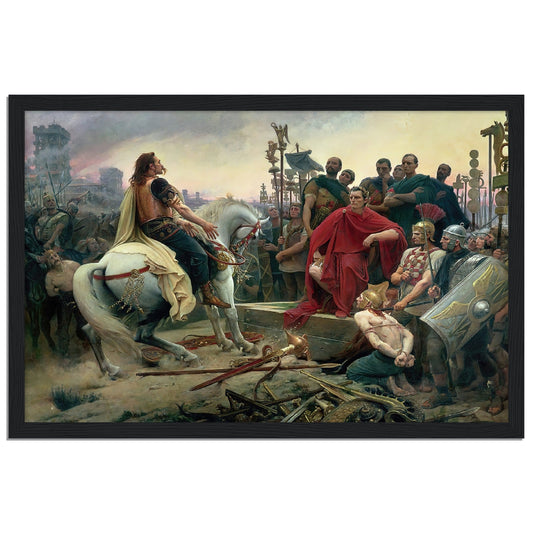
Vercingetorix surrenders to Julius Caesar by Lionel Royer: A Masterpiece of Historical Depiction
A defeated chieftain rides forward on a white horse, bathed in light, and hurls his weapons to the ground. Below him, seated and half in shadow, a Roman general watches without moving. It looks like the moment Rome finally conquered Gaul. It's actually the moment 19th-century France decided how it wanted to remember losing.
This is Vercingetorix Surrenders to Caesar, painted by Lionel Royer in 1899. It depicts a real historical event — but not quite the way it really happened, and understanding why tells you more about the painting than the battle itself does.
Table of Contents
- The Battle of Alesia, 52 BC
- Lionel Royer and a Defeat That Wasn't Forgotten
- Reading the Composition
- How Accurate Is It, Really?
- A National Symbol
The Battle of Alesia, 52 BC
The painting shows the surrender of Vercingetorix, chieftain of the Arverni tribe and leader of a confederation of Gallic tribes, to Julius Caesar after the Siege of Alesia in 52 BC. It was the decisive battle of the Gallic Wars.
Vercingetorix had retreated to the hilltop fortress of Alesia with his army. Caesar's legions encircled the town with a double ring of fortifications — one facing inward to trap the Gauls inside, one facing outward to block the relief force marching to break the siege. The plan worked. Gallic reinforcements failed to break through, food inside Alesia ran out, and after roughly two months under siege, the Gauls surrendered.
According to Caesar's own account in Commentarii de Bello Gallico, Vercingetorix addressed his assembly the next day, saying he had not fought for his own interests but for the freedom of all Gaul, and offered his own life if it would satisfy Rome. Weapons and Gallic leaders were brought before Caesar, who sat on a tribunal at the head of his camp. Vercingetorix was taken prisoner. He would spend roughly six years in Roman captivity before being executed following Caesar's triumph in Rome.
Lionel Royer and a Defeat That Wasn't Forgotten
Lionel Royer (1852–1926) was a French history painter who, as a young man, fought in the Franco-Prussian War of 1870–71 — the conflict in which France was decisively defeated, losing the territories of Alsace and Lorraine to the newly formed German Empire. It was a national humiliation that reshaped French culture for a generation, and it's essential context for this painting, made nearly three decades later.
In the aftermath of 1871, French art and education went looking for a hero who could represent greatness even in defeat — someone who had lost, but with dignity and resistance. Vercingetorix, a minor figure in most classical sources, was recovered for exactly this purpose. Royer's painting, completed in 1899, is part of that project. It doesn't just illustrate an event from 52 BC; it uses that event to say something about France in 1899.
Reading the Composition

The painting is enormous — over three metres tall and nearly five metres wide — and every choice in it favours the loser. Vercingetorix occupies the foreground on a white horse, lit brightly, his posture upright and defiant as he throws down his weapons. Caesar is pushed to the middle distance, seated, his face partly in shadow. The composition places the viewer's eye on the defeated man first.
The defeated Gallic warriors are gathered at the front of the scene in warm, luminous colour; the victorious Romans recede into darker, cooler tones behind them. It's a deliberate imbalance — Royer isn't painting Rome's triumph, he's painting Gaul's dignity.
How Accurate Is It, Really?
Historically, probably not very — and that's the most interesting thing about it.
The Roman historian Dio Cassius, writing in the 3rd century, described the actual surrender quite differently: Vercingetorix, he wrote, could have tried to escape, but instead approached Caesar directly, hoping for mercy, appearing suddenly before him — tall and formidable in his armour, unsettling those who saw him. There's no white horse in that account, no majestic ride into the Roman camp. Royer wasn't working primarily from Caesar's or Dio's texts; art historians have traced his composition to a popular illustrated 19th-century history book, and to visual conventions of the period — including the flowing moustaches on the Gauls, a stereotype of the era rather than a documented detail.
None of this makes the painting fraudulent. Royer wasn't claiming to be a documentary illustrator; he was making a national history painting in a genre where dramatic truth mattered more than archaeological precision. But it's worth knowing that the Vercingetorix most people picture — noble, towering, radiant on his white horse — is largely Royer's invention, built for an audience that needed a hero in 1899, not an eyewitness record of 52 BC.
A National Symbol

The town of Le Puy-en-Velay bought the painting in 1901, and it has hung in the Musée Crozatier ever since — a canvas so large it needs its own wall. But its real reach has been outside museum walls entirely: reproduced for generations in French school textbooks, it became one of the defining images through which French children learned about Vercingetorix, the Gallic Wars, and the idea of Gaul as the ancestor of modern France.
That's a rare kind of legacy for a painting: made as propaganda for a specific, forgotten political moment, and yet it outlived that moment to become simply the image of Vercingetorix — more real, in the popular imagination, than anything in the historical record.