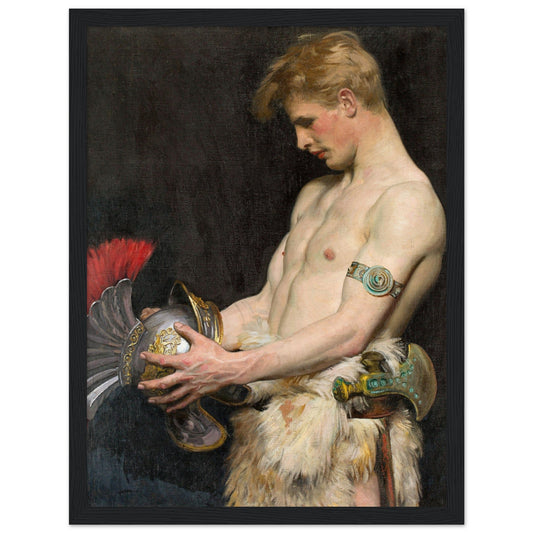
Germanic Warrior Looking At A Roman Helmet (1902), Osmar Schindler
A young warrior sits still, shirtless, his body marked by battle. In his hands he holds not a weapon but a Roman helmet — not wearing it, just holding it, staring into it as if trying to read something inside. This is Germanic Warrior Looking at a Roman Helmet, painted in 1902 by the German artist Osmar Schindler. It is a quiet painting about a loud subject: what it means to defeat an empire, and what's left once the fighting stops.
Table of Contents
- The Painting: A Moment After the Battle
- Who Was Osmar Schindler?
- Germans, Romans, and the Idea Behind the Image
- Where the Painting Stands Today
The Painting: A Moment After the Battle
Schindler doesn't paint a battle. He paints the moment right after one — the stillness that follows, rather than the chaos itself. The warrior is seated, his weight settled, his skin catching the light in the loose, painterly brushwork Schindler favoured. He isn't looking outward at the viewer. His eyes are fixed on the Roman helmet in his hands, and that single choice is what gives the painting its tension: this isn't a triumphant pose for an audience, it's a private moment the viewer happens to witness.
The helmet is doing a lot of work in this composition. It's the only Roman object in the frame, and it stands in for the entire empire it belonged to — the armies, the roads, the idea of Rome as the dominant power of the ancient world. A Germanic warrior holding it, examining it rather than wearing it as a trophy, reads less like boasting and more like reckoning. Whether the expression is pride, exhaustion, or something closer to doubt is left open. Schindler gives no caption, no title character, no battle name — just the object and the gaze.

Who Was Osmar Schindler?
Osmar Schindler was born on 21 December 1867 in the village of Burkhardtsdorf, in what was then the Kingdom of Saxony, and grew up in the nearby town of Bischofswerda. He lost his father while still a child, and it was an uncle who paid for his education at the Dresden Academy of Fine Arts, where he trained under the historical painter Ferdinand Pauwels and the portraitist Leon Pohle. His fellow students there included Sascha Schneider and Hans Unger, both of whom went on to become notable Art Nouveau artists in their own right.
By 1895 Schindler had travelled through Belgium, the Netherlands, France, and Italy, absorbing the artistic currents of the period. His mature style sits between Impressionism and Art Nouveau — loose, atmospheric brushwork paired with a strong decorative sense of line. He later returned to the Dresden Academy as a professor, teaching the next generation of students there.
Schindler's output was wide-ranging: religious scenes, portraits, and history paintings sat alongside decorative work for churches and public buildings. Among his best-known paintings is Im Kumtlampenschein (1901), which won a gold medal at the Dresden International Art Exhibition the year before he painted the Germanic warrior. He also painted an altarpiece depicting the Crucifixion for a church in Dresden, and portraits of prominent academic figures of his day, including the engineer Christian Otto Mohr. He died in Dresden on 19 June 1927, at the age of 59.
Germans, Romans, and the Idea Behind the Image
Schindler painted this warrior in 1902, at a moment when German artists were often drawn to subjects from the ancient Germanic past — a period seen, in the historical imagination of the time, as the origin point of a distinct national identity, forged in resistance to Roman power. The clash between Rome and the Germanic tribes was a real and recurring feature of the ancient world for centuries, most famously in the Roman defeat at the Teutoburg Forest in 9 AD, when Germanic warriors led by Arminius destroyed three Roman legions.
Schindler doesn't illustrate any single battle. There's no legion number, no named chieftain, no specific date attached to the scene. What he paints instead is the aftermath as an idea — a single figure holding the symbol of the empire he has just faced, at the exact moment before that object becomes a trophy, a memory, or a warning. That ambiguity is likely deliberate. It lets the painting work as both a historical genre scene and a quieter meditation on what victory actually costs the person who wins it.
Where the Painting Stands Today
Germanic Warrior Looking at a Roman Helmet remains one of Schindler's most reproduced works, still circulating well over a century after it was painted — a sign of how much the image itself, independent of any specific story attached to it, continues to hold attention.
Part of what keeps it compelling is exactly what it withholds. Schindler gives no name, no battlefield, no resolution — only a young man, a Roman helmet, and a look that could mean triumph, exhaustion, or doubt, depending on who's looking at it. That's a lot of weight for one quiet figure to carry, and more than a century later, it still does.