The Lady with an Ermine by Leonardo da Vinci
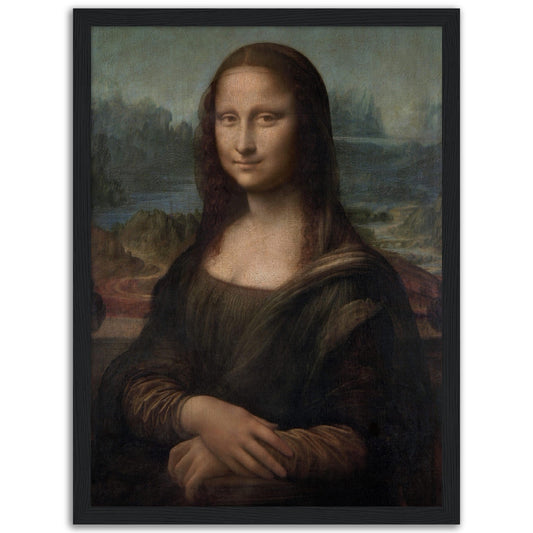
Leonardo da Vinci's Lady with an Ermine anticipates the beauty of the far more famous Mona Lisa. Despite that, it has never reached the same fame — even though it holds just as many secrets.
Who is the girl in the portrait? What does the ermine symbolise? Why was this painting an artistic novelty for its time? And what love story sits behind it?
Table of Contents
- The Background
- Condition and Restoration
- Who Is the Lady with an Ermine?
- The Love Story
- The Psychology Behind the Painting
- The Symbolism of the Ermine
The Background
Leonardo painted this portrait of a young woman in Milan, during the years he served as court artist to Ludovico Sforza, known as "il Moro." It's generally dated to 1488–1490.
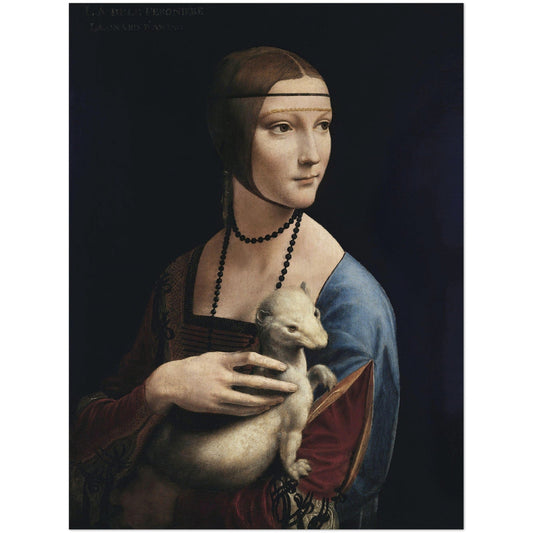
Leonardo starts from a typical fifteenth-century format — half-length, three-quarter turn — and then breaks from it. He rotates the sitter's torso slightly to the left, opposite the direction her head turns, and has the ermine in her arms twist the same way, creating a contrapposto he had already begun exploring with the angel in The Virgin of the Rocks. It's one of the most important technical choices in the painting, because it opens up space for something portraiture rarely attempted before: a sense of psychological movement, not just physical likeness. Through the "motion of the body," Leonardo suggests the motion of the soul underneath it.
The sitter's smile is famously enigmatic, almost imperceptible — a quality that shares real affinities with the smile Leonardo would later paint on the Mona Lisa. Her long, tapered fingers rest on the ermine's fur, describing a gentle, deliberate presence. Leonardo also renders her in a "Spanish-style" hairstyle fashionable in Milan at the time: hair smoothed and centre-parted, gathered into a sheathed ponytail, with a single lock left loose beneath the chin, and a thin, transparent cap with an embroidered hem sitting low over her eyebrows. Even in these details, the painting doubles as a precise record of Lombard fashion in the late 1480s.
Condition and Restoration
Before getting to the symbols hidden in this painting, it's worth knowing what condition it's actually in.
Despite a few areas of minor damage, the art historian Frank Zöllner has described the panel as being in very good condition, comparable to the similarly well-preserved Mona Lisa. That assessment is relatively recent. For decades the painting was believed to be significantly damaged and reworked, largely on the authority of the historian Kenneth Clark, who argued in 1961 that the entire left side of the figure and the background had been repainted.
A technical analysis carried out at the National Gallery of Art in 1992, led by David Bull, overturned that view: the damage turned out to be limited to the background. That background, now black, was likely originally a bluish-grey, painted over in black sometime in the mid-18th century — along with the signature "LEONARD D'AWINCI" added in the top left corner, which is not believed to be original. There's also minor overpainting around the mouth and nose.
One older theory has since been disproven entirely: a 1955 X-ray study at the Warsaw laboratories, led by Kazimierz Kwiatkowski, interpreted certain marks in the background as the remains of a painted window. Later analysis showed this wasn't the case.
Who Is the Lady with an Ermine?
Her name was Cecilia Gallerani. She came from a good Milanese family, and by the time Leonardo painted her she was around fifteen years old and the acknowledged mistress of Ludovico Sforza, then in his thirties. Renaissance Italy had very different customs around age and marriage than we do today — a fact worth keeping in mind rather than judging by modern standards, and one this section will return to.
The Love Story
In 1483, when Cecilia was ten, her mother arranged her betrothal to Giovanni Stefano Visconti, a man twenty-four years her senior — a common way, at the time, to avoid sending an unmarried daughter into convent life. The marriage, planned for when she turned twelve, never took place. Historians generally attribute this to a more advantageous match appearing for the Gallerani family: the still-unmarried Ludovico Sforza.
Exactly when Cecilia and Ludovico met isn't documented. By 1489, at sixteen and still unmarried, she was already living independently rather than in her father's house or a convent — itself a sign of Ludovico's involvement in her life. A surviving letter from July 1484, in which Ludovico writes of his pleasure in a young Milanese woman of notable birth, "as honest and shapely as I could wish," has led some historians to date the start of the relationship to around then, when Cecilia would have been about fourteen.
On 17 January 1491, Ludovico married Beatrice d'Este. His relationship with Cecilia continued regardless, and not long after, Cecilia became pregnant. Beatrice, once she learned of the affair, wasn't reported to be jealous of it in the way one might expect — she was reportedly pleased at the birth of Ludovico's illegitimate son, Cesare. The one flash of anger on record wasn't about the relationship itself, but about court etiquette: when she discovered that Ludovico had commissioned matching dresses for her and Cecilia, she was furious, and had Cecilia barred from wearing hers. Ludovico, for his part, didn't entirely honour his side of the peace either — he later slipped away from court for five days specifically to see Cecilia.

The Psychology Behind the Painting
As mentioned above, Leonardo uses the contrapposto twist to let the body's motion suggest the mind's. Both Cecilia and the ermine look off to the left, and her expression resists a single reading — it isn't clearly happy or troubled. Two interpretations are usually offered: that she's looking toward Beatrice, the wife who has just learned of the affair, or toward Ludovico himself, watching her with open affection.
The Symbolism of the Ermine
The ermine carries several layers of meaning, often working together rather than replacing one another.
The animal was a traditional symbol of purity and virtue, which fits neatly as a reference to Cecilia's own character. There's also likely a play on her surname: the Greek word for ermine, galé, echoes "Gallerani." Leonardo had used a very similar trick before, surrounding Ginevra de' Benci with juniper — ginepro in Italian — in an earlier portrait. This kind of visual pun was common practice in Renaissance portraiture.
The ermine also had personal significance for Ludovico Sforza, who used it as a personal emblem after being inducted into the Order of the Ermine by King Ferdinand I of Naples in 1488. Moderation and purity were qualities associated with Ludovico himself, and Leonardo wrote about the ermine in exactly those terms in his own notebooks: that the animal would rather be caught by hunters than take refuge in a dirty den, and that it would rather die than stain itself.
A final layer of symbolism ties to Cecilia's circumstances at the time the portrait was painted: in classical tradition, the ermine was also associated with pregnancy and seen as a protective figure for women expecting a child — which Cecilia, by most datings of the painting, was.