Leonardo da Vinci's Childhood: The Virgin and Child with Saint Anne
Share
The Virgin and Child with Saint Anne is a famous, unfinished painting by Leonardo da Vinci, and one of his strangest. Is Saint Anne meant to be a stand-in for Leonardo's own mother? What does the bird hidden in the folds of Mary's dress actually mean? This article works through both questions — including the psychoanalytic reading that made this quiet devotional scene one of the most argued-over paintings in art history.
Table of Contents
- The Painting
- Leonardo's Dream
- Freud's Interpretation
- The First Interpretation
- The Second Interpretation
- The Third Interpretation
- Leonardo's Smiles
The Painting
It's likely the painting was commissioned by King Louis XII of France following the birth of his daughter in 1499, though it was never delivered to him.
The work depicts three generations of Christ's family: Saint Anne, her daughter Mary, and the infant Jesus. Looking closely at their positioning, Mary is actually seated on Saint Anne's lap — an unusual choice whose exact meaning still isn't settled among scholars. Neither woman's precise age is stated in the painting, but Leonardo subtly distorts the visual cues so that Saint Anne reads as noticeably older than her daughter, reinforcing the mother–daughter relationship even though the two are close in apparent age. The child holds a lamb; Mary gazes into her son's eyes, while Saint Anne looks toward Mary. That chain of glances — grandmother to mother, mother to child — seems to be making a quiet point about the relationship between the three figures.
The composition follows a pyramidal structure common to Renaissance altarpieces, with Saint Anne's head at the apex — a placement that gives her a kind of pre-eminence over the scene. Her expression is benevolent, almost smiling, rendered with the mature, ambiguous physiognomy typical of Leonardo's late work. Some readings take her to symbolise the Church itself, restraining Mary's maternal instinct to protect her son and reaffirming, instead, the necessity of Christ's voluntary sacrifice.
The light is soft, the colour carefully modulated, with atmospheric effects linking the monumental foreground figures to a vast, high-horizon landscape behind them — mountains fading into pale, hazy tones through aerial perspective. That muted, misty background makes the solidity of the central group stand out even more, its gestures and gazes built on a careful, almost architectural balance of diagonals.
Leonardo's Dream
One symbol is worth pausing on. In the folds of Mary's dress, it's possible to make out the shape of a bird — and that shape connects to a childhood memory Leonardo recorded himself, in the Codex Atlanticus.
While writing notes on the flight of birds, Leonardo included a memory from his infancy: as a baby in his cradle, he wrote, a bird had flown in through the window, approached him, and opened his mouth with its tail, striking it against his lips several times. For Leonardo, this memory was the explanation — the origin story — for his lifelong fascination with the flight of birds.
Freud's Interpretation
Sigmund Freud took that same memory and built an entire psychoanalytic study around it, in his 1910 essay Leonardo da Vinci and a Memory of His Childhood. It remains one of the most famous, and most contested, applications of psychoanalysis to art history.
The First Interpretation
Freud's first move was to read the bird as a stand-in for the phallus, turning the memory into a symbolic act of oral contact. From there, he placed Leonardo within what he saw as a recognisable pattern among the homosexual patients he had studied clinically: a childhood shaped by an intense maternal bond alongside an absent or distant father. Freud connected this to what's known of Leonardo's early years, largely raised by his mother Caterina alone before later joining his father's household. As supporting evidence, Freud pointed to Leonardo's meticulous, almost maternal record-keeping around expenses for his young apprentices — a kind of caretaking, in Freud's reading, that echoed the only caretaking Leonardo had known as a child.
The Second Interpretation
A second reading traces the bird's motion back to something more literal: the sensation of breastfeeding. In this version, Freud substitutes the bird directly for the mother — a mother who, in caring for her son entirely alone, took on the role of the missing father as well as her own. Freud argued that Leonardo, discovering his own sexuality in infancy with no father present and no awareness of any alternative, effectively became "the son of a mother alone" in a lasting psychological sense — one that his later years in his father's household, he believed, never fully resolved.
The Third Interpretation
A third reading takes a gentler approach. In this version, Caterina's love for her infant son was so intense, so physically expressed, that it left a distorted trace in his memory — the bird's tail striking his lips reframed, later, as the memory of his mother's own intense kisses. Freud connects the passivity in Leonardo's memory (the child being acted upon, unable to reciprocate or resist) to the position of any infant receiving that kind of affection. And he offers a reason for the intensity itself: that Caterina's devotion to her son was, in part, how she compensated for having been abandoned by the man she loved.
Leonardo's Smiles
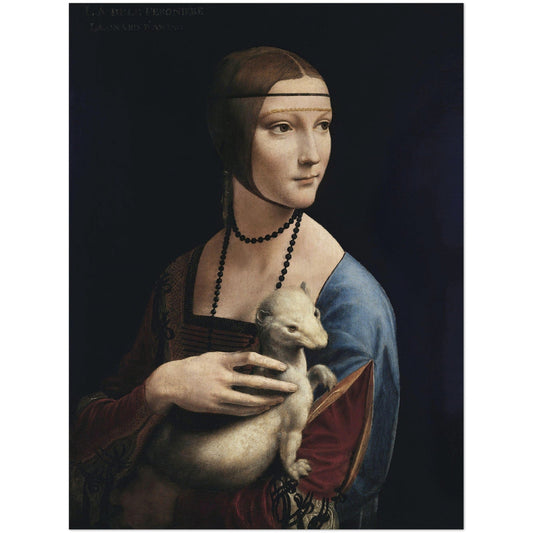
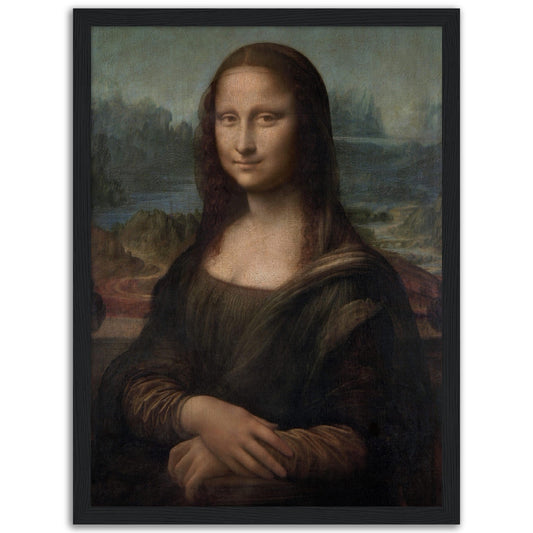
"Leonardo's smile" refers to the enigmatic half-smile that recurs across his paintings — most famously on the Mona Lisa. Freud traced that smile, and its underlying duplicity, back to Leonardo's own mother. The same smile appears here, on Saint Anne, in a painting where Freud found further traces of Leonardo's childhood. Saint Anne is rendered as a woman past her first youth but showing no real signs of age; Mary, meanwhile, is young, her arms extended toward her son. In Freud's reading, it's Saint Anne, not Mary, who stands in for Leonardo's own memory of his mother.